
In This Article
The short version
- Tier badges and certifications tell you a partner is active. They don't tell you if they can fix your specific problem.
- The best signal is how they diagnose. Great partners ask about your sales process before they talk about HubSpot features.
- Ask to see real work, ask who does the work, and ask what you'll own when it's done.
HubSpot's Solutions Directory lists thousands of partners. Most of them have nice websites, good reviews, and the same list of services. So how do you actually choose?
After ten years of HubSpot work, including a lot of cleanup after other partners, these are the questions we'd ask if we were in your seat.
Questions About How They Think
1. "What would you need to know before recommending anything?"
You want to hear questions about your sales process, team structure, handoffs, and data. If the first answer is a feature list, they're selling, not diagnosing.
2. "What would you fix first, and why?"
Good partners prioritize by revenue impact. Usually that means data and process first, then automation, then AI. Anyone who leads with AI on top of messy data is going to build you an expensive mess faster.
3. "When would you tell us not to buy something?"
Partners can earn revenue share on HubSpot upgrades. That's fine, as long as they'll tell you when your current tier already does the job.
Questions About Proof
4. "Can you walk me through a real portal you built?"
Not a slide. A screen share of a real workflow, dashboard, or pipeline, with client data hidden. Real builders can explain why every piece is there.
5. "What results did a similar client get?"
Look for numbers tied to business outcomes: meetings booked, closed-won deals, faster response time, hours saved. "We built 40 workflows" is not an outcome.
6. "Can I talk to a client?"
Reviews on the HubSpot directory and sites like Clutch are a good start. A reference call is better.
Questions About the Work
7. "Who will actually do the work?"
Some agencies sell with senior people and deliver with juniors. Ask who's on your account and how much HubSpot experience they have.
8. "How do you handle scope changes?"
Scope always moves. You want a partner who says so upfront and has a clear process, not one who surprises you with an invoice.
9. "How will we communicate?"
Weekly check-ins, a shared channel, written status reports. Silence is the most common reason partner relationships go bad.
Questions About What You Keep
10. "What will we own when you're done?"
The right answer: everything. Documentation, training recordings, SOPs, and a portal your team understands.
11. "How do you train our team?"
Adoption is where ROI comes from. Look for role-based training inside your own portal, not a generic tour.
12. "What happens after launch?"
Systems drift. Ask about ongoing support, monitoring, and how improvements get prioritized.
Red flags: long contracts before an audit, no examples of real work, pushing an upgrade in the first call, and vague answers about who owns what you build.
A Simple Way to Decide
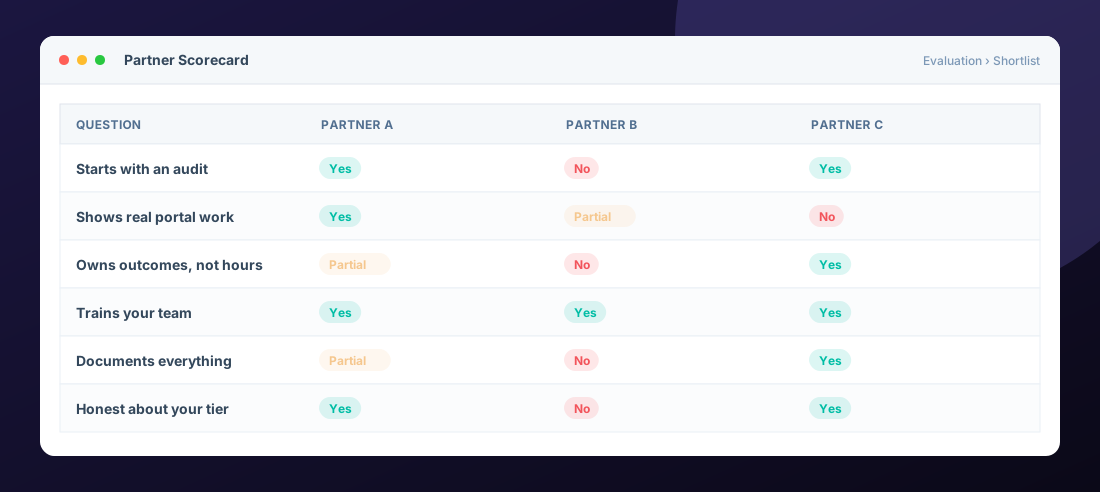
Shortlist three partners, ask all twelve questions, and score each answer. Then pick the one whose first instinct was to understand your business. In our experience that predicts the outcome better than any badge.
Frequently Asked Questions
Does a higher partner tier mean better work?
Not necessarily. Tiers mostly reflect how much HubSpot revenue a partner manages. Smaller specialist partners often go deeper on technical CRM and RevOps work.
Should we pick a HubSpot partner in our industry?
Industry experience helps, but process experience matters more. A partner who has fixed lead routing and pipeline reporting many times will usually adapt quickly to your industry.
How long should a partner contract be?
Start with a scoped audit or project. For ongoing work, a short minimum commitment is normal so the partner can show results, with flexibility after that.
Can a partner work alongside our in-house admin?
Yes. Many teams keep an internal owner and use a partner for heavier builds, strategy, and backup.
Helpful HubSpot Knowledge Base articles
Explore all 10 HubSpot services →

HubSpot Solutions Architect at Zentavra, a certified HubSpot Solutions Partner. Ten years and 200+ HubSpot builds for B2B sales, marketing, and service teams.